EmptyModifier in SwiftUI: Debug-Only View Modifiers That Vanish From Release Builds
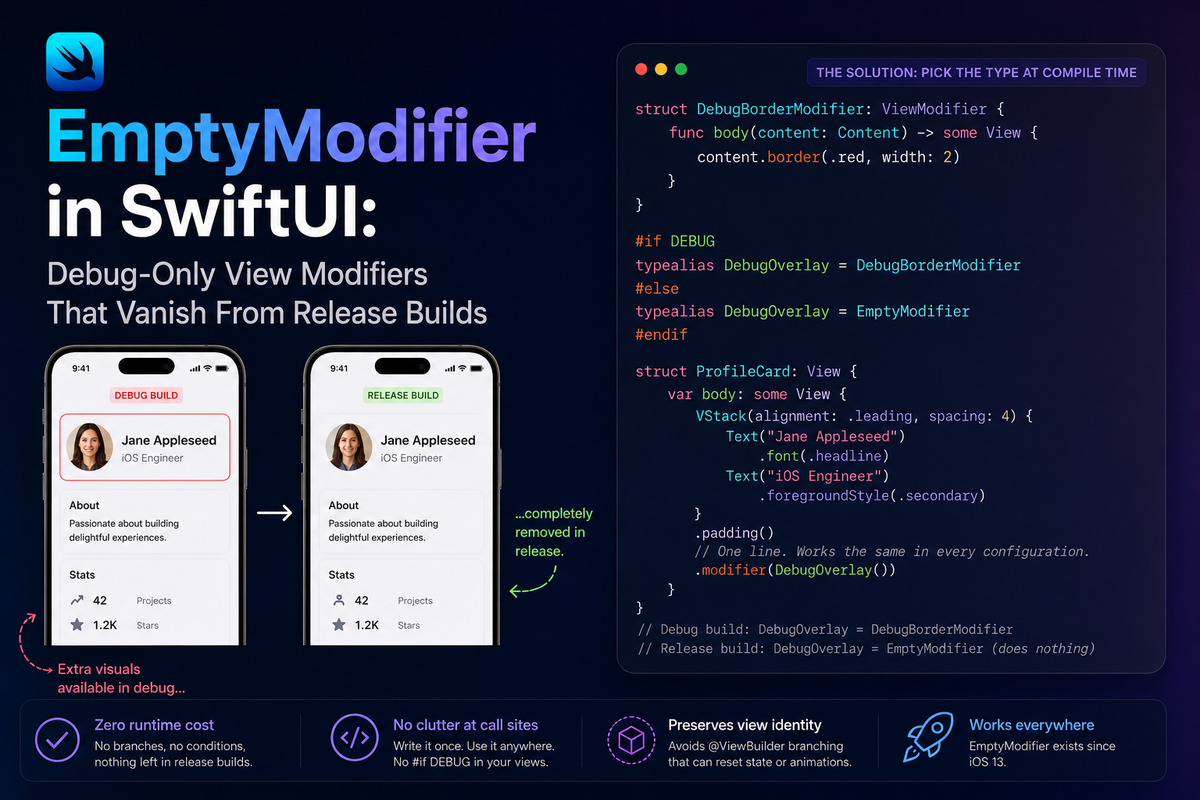
Every SwiftUI codebase collects a few view modifiers that should only exist during development: a red border around a view that's fighting the layout system, a caption showing a view's live frame size, an overlay flagging which cell came from a mock network response. The obvious fix is to scatter #if DEBUG around each call site, but that clutters every screen that needs one of these, and it's easy to forget a spot when the flag changes. The next instinct is to hide the branch inside a single shared modifier instead — until you try to write it and discover that swapping between two different ViewModifier types at runtime doesn't type-check the way it does for view content. SwiftUI already ships the piece that solves this cleanly: EmptyModifier, the modifier system's identity element, paired with a typealias resolved at compile time rather than a check resolved at runtime.
What EmptyModifier actually is
EmptyModifier conforms to ViewModifier, and its body(content:) implementation does the least interesting thing possible: it hands back content completely untouched. On its own, a modifier that does nothing isn't useful. What makes it useful is that it's a real, concrete type — not a special case, not nil, not an optional you have to unwrap — so it can stand in anywhere the type system expects a ViewModifier. That includes standing in as one half of a typealias that gets picked between at compile time.
Why the obvious fix doesn't compile
The first thing most people try looks like this:
struct DebugBorderModifier: ViewModifier {
    func body(content: Content) -> some View {
        content.border(.red, width: 2)
    }
}

struct ProfileCard: View {
    var body: some View {
        Text("Jane Appleseed")
            // Does not compile — DebugBorderModifier and EmptyModifier
            // are different concrete types; the ternary needs one type.
            .modifier(Bool.random() ? DebugBorderModifier() : EmptyModifier())
    }
}
It fails, and the error is instructive. DebugBorderModifier and EmptyModifier are two different concrete structs. Swift's ternary operator needs both branches to resolve to the exact same type — it doesn't get the opaque-type inference a function's -> some View return position gets, where the compiler is free to hide which concrete type comes back as long as every path through the function agrees. A value evaluated with ?: doesn't have that luxury.
From there, the next stop for most developers is a @ViewBuilder-based .if() extension, which does type-check:
extension View {
    @ViewBuilder
    func `if`<Content: View>(
        _ condition: Bool,
        transform: (Self) -> Content
    ) -> some View {
        if condition {
            transform(self)
        } else {
            self
        }
    }
}

var isDebugBuild: Bool {
    #if DEBUG
    true
    #else
    false
    #endif
}

struct ProfileCard: View {
    var body: some View {
        Text("Jane Appleseed")
            .if(isDebugBuild) { view in
                view.border(.red, width: 2)
            }
    }
}
It's also the wrong tool for this specific job, for reasons the gotchas section below covers.
Swapping the type before the compiler runs
struct DebugBorderModifier: ViewModifier {
    func body(content: Content) -> some View {
        content.border(.red, width: 2)
    }
}

#if DEBUG
typealias DebugOverlay = DebugBorderModifier
#else
typealias DebugOverlay = EmptyModifier
#endif

struct ProfileCard: View {
    var body: some View {
        VStack(alignment: .leading, spacing: 4) {
            Text("Jane Appleseed")
                .font(.headline)
            Text("iOS Engineer")
                .foregroundStyle(.secondary)
        }
        .padding()
        .modifier(DebugOverlay())
    }
}
The trick is choosing the concrete type of DebugOverlay before compilation happens at all, using #if DEBUG around the typealias declaration rather than around a value. In a debug build, DebugOverlay is DebugBorderModifier, and .modifier(DebugOverlay()) draws the border. In a release build, DebugOverlay is EmptyModifier, and the same line compiles down to .modifier(EmptyModifier()), which SwiftUI resolves straight through to content with nothing left to run. The call site, .modifier(DebugOverlay()), is written exactly once and never has to change no matter which configuration is currently building.
The pattern scales past a single flag, too — each debug-only concern gets its own modifier and its own typealias, so a screen can carry several independent pieces of debug-only chrome without a single #if inside its body:
struct DebugSizeLabelModifier: ViewModifier {
    func body(content: Content) -> some View {
        content.overlay(alignment: .topTrailing) {
            GeometryReader { proxy in
                Text("\(Int(proxy.size.width))x\(Int(proxy.size.height))")
                    .font(.caption2)
                    .padding(2)
                    .background(.yellow)
            }
        }
    }
}

#if DEBUG
typealias DebugSizeLabel = DebugSizeLabelModifier
#else
typealias DebugSizeLabel = EmptyModifier
#endif

struct ThumbnailGrid: View {
    let images: [UIImage]

    var body: some View {
        LazyVGrid(columns: [GridItem(.adaptive(minimum: 80))]) {
            ForEach(images.indices, id: \.self) { index in
                Image(uiImage: images[index])
                    .resizable()
                    .aspectRatio(contentMode: .fill)
                    .modifier(DebugSizeLabel())
            }
        }
    }
}
Edge cases and gotchas
A ternary between two modifiers won't compile, and that's the tell you're missing the typealias. If you find yourself reaching for AnyView-style erasure just to make a debug modifier conditional, that's a sign to move the branch to the type level with a typealias instead — it's less code, and unlike an erased type, it disappears entirely from release builds.
The .if() extension is the wrong tool for something meant to be invisible. It type-checks and it feels equivalent, but it costs two things the typealias trick doesn't. First, the if/else branch stays in the compiled release binary — the condition is still evaluated and the modifier's code is still linked in, it just always takes the same branch. Second, SwiftUI treats the if and else branches of a @ViewBuilder as two different positions in the view tree. Toggling the condition can be read by SwiftUI as replacing one view with a different one rather than modifying the same view in place, which can drop @State, restart animations, or re-fire .onAppear — an odd side effect for a modifier that's only supposed to draw a border.
EmptyModifier has been around since SwiftUI's first release, iOS 13, so this pattern is safe on old deployment targets — it isn't gated behind a newer OS version the way some more ergonomic debug tooling, like Xcode preview traits, is.
Summary
EmptyModifier is a small, quiet type — a modifier whose only job is to do nothing — but pairing it with a build-time typealias turns it into a way to write debug-only view code exactly once and have it fully disappear from release builds without a stray #if at the call site. The fix for "how do I switch between two modifiers" is rarely a runtime check; it's picking the type before the compiler starts.